
He had been a .NET and C# developer for seven years. He was good at the work. He delivered on time, wrote clean code, and had earned the “senior” title on his badge. None of that had translated into growth.
Service-company work has a particular rhythm: a project comes in, you build it, the client takes it away, and you start again with the next one. The domain changes — retail one month, insurance the next — but the seniority floor and the compensation ceiling stay frustratingly stable. There is rarely a product to own, a codebase to deepen, or a decision to influence.
“I kept thinking I’d get the break that changed things. A client who wanted a long-term engagement, or a move to a product company, or some recognition that opened a door. I waited seven years for a break that wasn’t coming.”
By the time AI became impossible to ignore, he felt it acutely. He watched engineers in product companies ship AI features, build portfolios around them, and land roles at the kind of companies he’d spent years hoping to join. He had none of that. He had a list of things he probably needed to learn and no idea where to start.
The problem with lists
He tried the obvious approaches. He built a reading list. He saved YouTube playlists. He wrote “learn AI” in his personal notes more than once, under different headings, as if rewriting the goal might produce a plan.
It didn’t.
The problem was not motivation. The problem was that none of these formats showed him what depended on what. He didn’t know whether to learn Python before or alongside C# AI tooling. He didn’t know if a certification would matter more or less than a portfolio project. He didn’t know whether his existing .NET skills were an asset or a liability — whether to lean into them or build around them.
A flat list cannot show dependencies. It cannot show you what is blocked, what is next, or what you are actually working toward. It just shows you a pile.
Treating the career problem like a product problem
He worked in product delivery every day. He knew how to break a product into features, sequence them by dependency, and track what was in progress versus what was blocked. The thought — late on a Sunday, frustrated with another abandoned YouTube series — was that the career problem had the same structure as a product problem.
It had inputs. It had outputs. Some things had to happen before other things could. There was a goal at the end, and there were constraints along the way. What it lacked was a canvas.
He opened Stokik and started mapping it.
The canvas
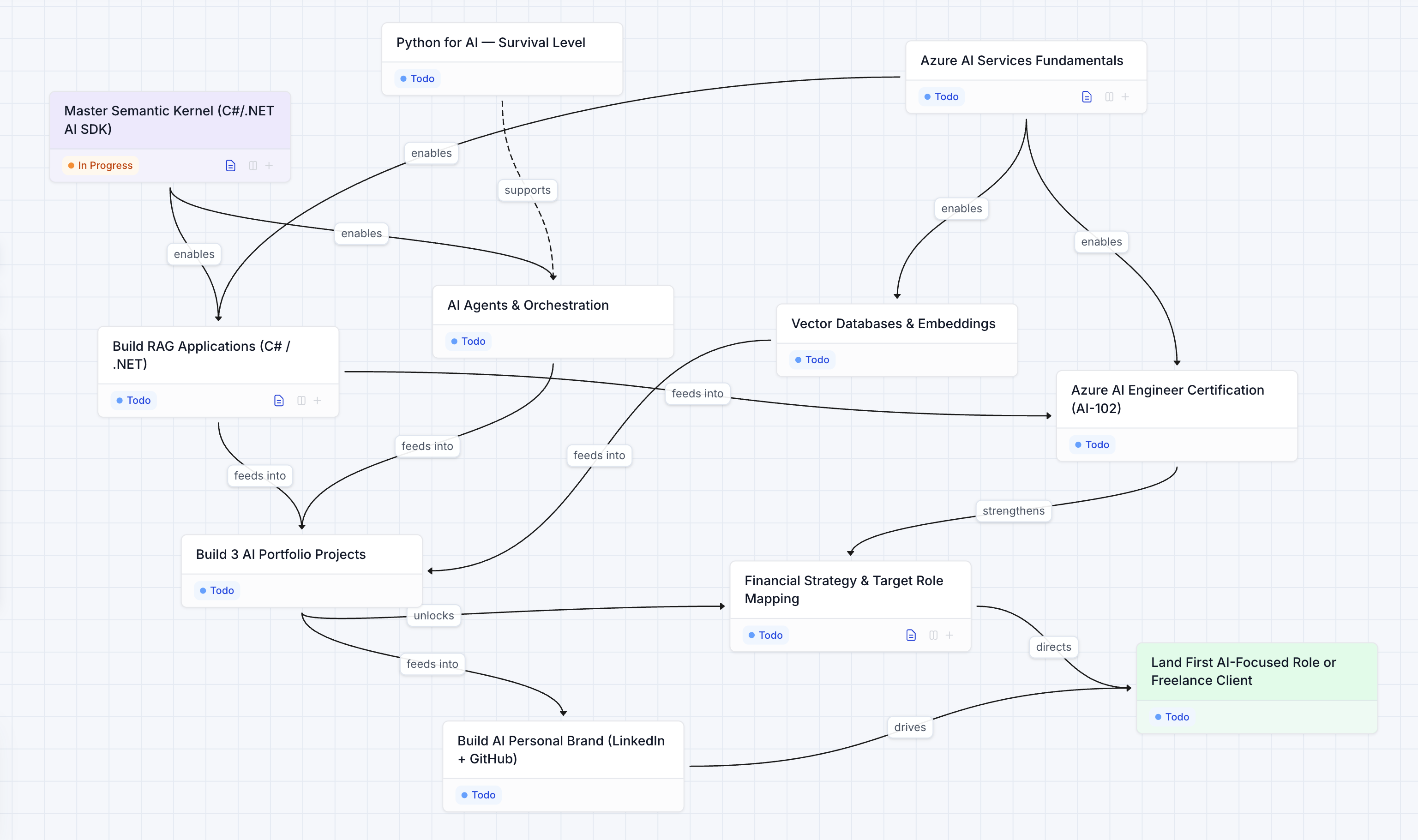
The canvas became a dependency graph of every skill and milestone between where he was and where he wanted to be.
At the left: Python for AI — Survival Level, the foundation nothing else could start without. From there, two parallel tracks: Master Semantic Kernel (C#/.NET AI SDK) — which let him leverage seven years of existing skills rather than discard them — and Azure AI Services Fundamentals, the cloud layer his current employer already used. Those two fed into Build RAG Applications (C#/.NET), the pattern he kept seeing in AI job specs, and Vector Databases & Embeddings, which underpinned it. RAG unlocked AI Agents & Orchestration, the more advanced capability he wanted to be able to demonstrate. Threading through the whole sequence: Azure AI Engineer Certification (AI-102), Build 3 AI Portfolio Projects, Build AI Personal Brand (LinkedIn + GitHub), and at the far right — the goal — Land First AI-Focused Role or Freelance Client.
Edge labels made the relationships explicit: enables, supports, feeds into, unlocks, strengthens, directs, drives. Not just arrows — reasons. You could read the canvas and understand not just the order but the logic.
The documents
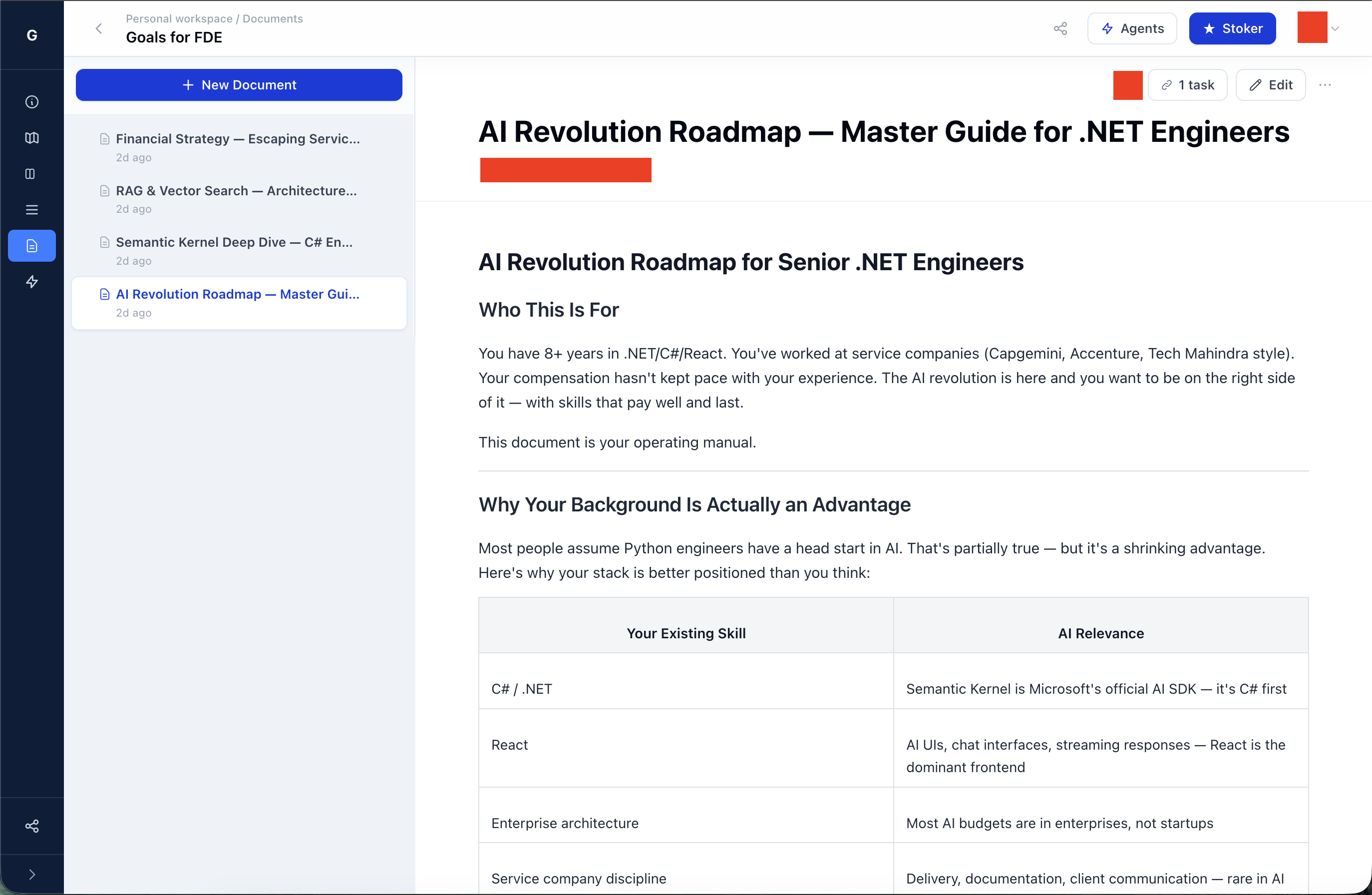
Attached to the project were four documents, each linked directly to the canvas they sat alongside.
“Financial Strategy — Escaping Service Company Compensation Trap” set out the salary target, the minimum viable timeline to reach it, and the financial buffer needed before making a move. “AI Revolution Roadmap — Master Guide for .NET Engineers” was his high-level thinking about where the field was going and why the Azure/Semantic Kernel path made sense for someone with his background — including a breakdown of how existing .NET skills translated directly into AI advantages. “Semantic Kernel Deep Dive” and “RAG & Vector Search” were working notes — reference material he’d previously scattered across browser bookmarks and half-finished Notion pages, now living directly alongside the plan they informed.
“I’d never put my notes and my plan in the same place before. They always lived separately — notes in one tool, plan in another, and neither one ever talked to the other. Having the documents linked to the canvas made the whole thing feel like one thing.”
What changed
The first thing that changed was that the anxiety became specific.
Anxiety about a career problem is often worst when the problem is shapeless. You don’t know what you don’t know. You can’t tell how far you are from where you want to be. Everything feels urgent and nothing feels tractable.
With the canvas mapped, he could see the shape of the work. He could see that Python for AI was a prerequisite he could begin immediately. He could see that Semantic Kernel was a genuine accelerator — a path that let him go further faster because of skills he already had, not despite them. He could see that certification was later in the sequence, not earlier, which freed him from the trap of studying for a certificate before he understood what he was certifying.
“I stopped feeling like I was behind everyone. I could see I was at a specific node in a specific graph. That’s a very different feeling from just generally not knowing enough AI.”
The financial document mattered too. Naming a number — a specific salary target, a specific date, a specific amount of savings that would make a move safe — turned an abstract escape fantasy into a plan with a constraint. He knew what he was aiming for. He knew what success looked like in concrete terms.
The result
Ninety days after mapping the canvas, the Python for AI track was complete and the Semantic Kernel deep dive was underway. His first RAG application — a document Q&A tool built over an internal knowledge base — was in progress as a portfolio project. The financial target was set. The plan was running.
He had not landed an AI role yet. That was still ahead of him on the canvas, waiting for the nodes before it to be marked done.
But the shape of the work was no longer a mystery. He knew where he was. He knew what was next. He knew what would unlock what.
“The canvas didn’t get me the job. It got me to the point where I could actually do the work to get the job. Before this, I kept starting things and stopping them because I didn’t know if I was working on the right thing. Now I know. That’s the whole difference.”
The canvas is a living document, updated weekly as nodes complete and the plan moves forward. The financial strategy document gets revised every month. The goal is still on the right edge of the canvas — but the path to it is no longer invisible.